The roll bending process, powered by the PBA Series Aluminum Bending Machine, precisely masters both strong-axis (200mm) and weak-axis (250mm) asymmetrical cross-sections, completely eliminating common processing issues such as springback and surface rippling.
In the evolution of modern architecture, the curtain wall has transcended its role as a mere “skin” for buildings; it has evolved into a sophisticated structural statement. As global landmarks shift toward diverse, artistic expressions, curved and hyperbolic components have become the signature design language for commercial complexes and cultural hubs. However, for those on the shop floor, the curtain wall profile—especially large-section, multi-hollow aluminum extrusions—remains the “most difficult beast to tame” in the world of metal forming.
The Shop Floor Reality: A Chess Match Against Physics
If you spend enough time on the shop floor of a high-end architectural glazier, you eventually hear veteran operators describe curtain wall bending as a high-stakes chess match against the laws of physics. These profiles are rarely simple; they are complex, asymmetrical beasts often packed with integrated thermal breaks. The challenge begins with what fabricators call the “geometric trap.” An architect might draw an elegant sweep on a CAD screen that looks stunning, but once that aluminum hits the rolls, the cross-section often rebels. When a radius is pushed beyond the physical limits of the profile’s height, the compression zone becomes unstable. Instead of a graceful curve, you get scrap.
This struggle is intensified by the modern “thin-wall dilemma.” In the quest for lightweight, cost-effective designs, wall thicknesses are being stripped back to the bare minimum. This leaves the profile without the structural “meat” required to resist buckling, causing expensive extrusions to collapse like a soda straw the moment pressure is applied. Even when the geometry is sound, the “T6 temper trap” remains. While high-strength 6061-T6 aluminum offers the structural integrity skyscrapers demand, its low elongation makes it notoriously difficult to coax into a curve. Bending it directly leads to massive springback hurdles and the constant, looming threat of stress cracking that could compromise a building’s integrity.
Beyond structural failure, the industry is haunted by rigid surface requirements. Architectural facades are utterly unforgiving; a single “orange peel” ripple, a fold mark, or a mechanical scuff can lead to the rejection of an entire batch after the high-contrast finish of fluorocarbon spraying or anodizing is applied. These errors have a cumulative effect. Because curtain walls are precision-assembled systems, a radius deviation of just a few millimeters on a single mullion means the glass panels simply won’t seat on-site. In the field, there is no such thing as “close enough”—if the curve isn’t honest, the project timeline begins to unravel.
The Technical Core: Orchestrating the Three Pillars
To translate an architectural vision into a safe engineering reality, a shop must move beyond brute force and adopt a strategy built on three pillars: shape control, property control, and surface control. In leading industrial hubs, this has triggered a digital reshaping of geometric precision. Modern shops have retired the manual template in favor of 3D scanning and real-time comparison against BIM models. By precisely calculating the neutral axis shift—that invisible line where the metal neither stretches nor compresses—technicians are now achieving millimeter-level tolerances even on the most complex multi-radius and compound curves.
Mastering the metallurgy requires a deep understanding of the material’s “memory.” To conquer springback, advanced fabricators are turning to stretch-bending techniques that apply axial tension during the curve. This tension redistributes the internal fibers of the metal, effectively “erasing” its memory and eliminating the dead wrinkles that plague high-strength T6 alloys. This mechanical sympathy extends to surface protection as well. Improved machine designs now incorporate full-process support functions, utilizing customized non-metallic polymer tooling. This “soft-touch” approach ensures a zero-scratch process, maintaining a flowing, flawless finish throughout the entire length of the extrusion.
Intelligence in the Heavy-Duty Arena
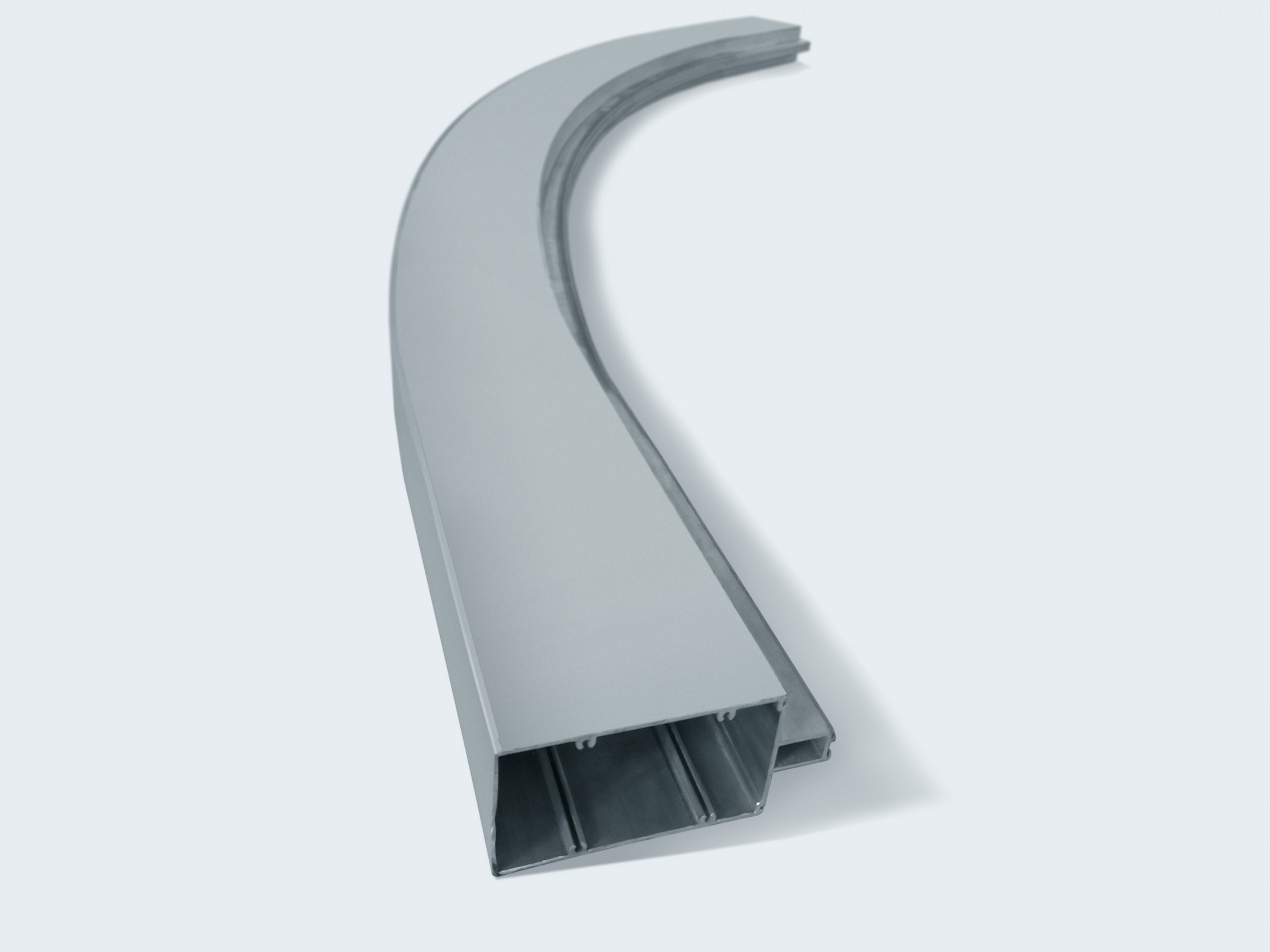
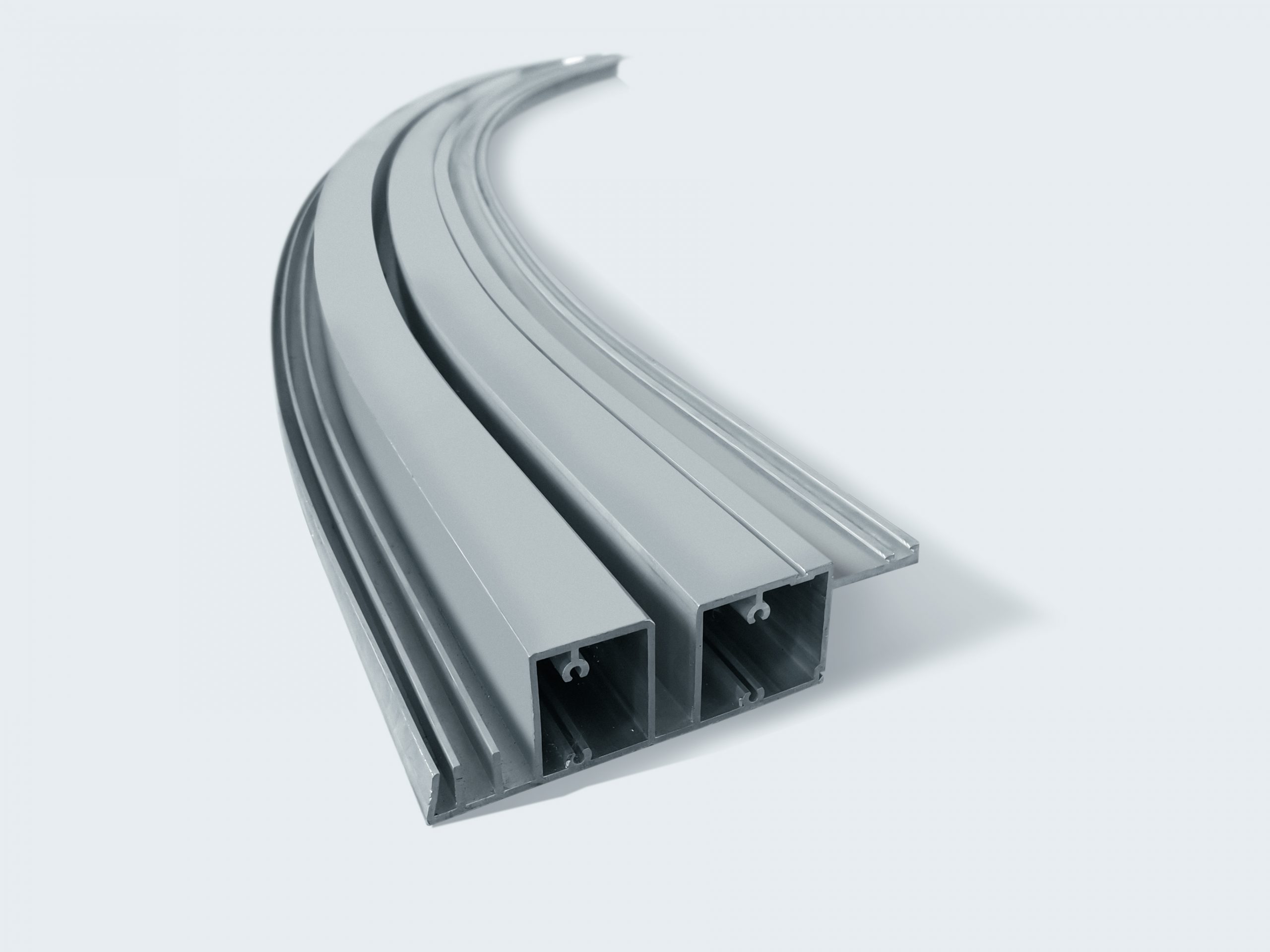
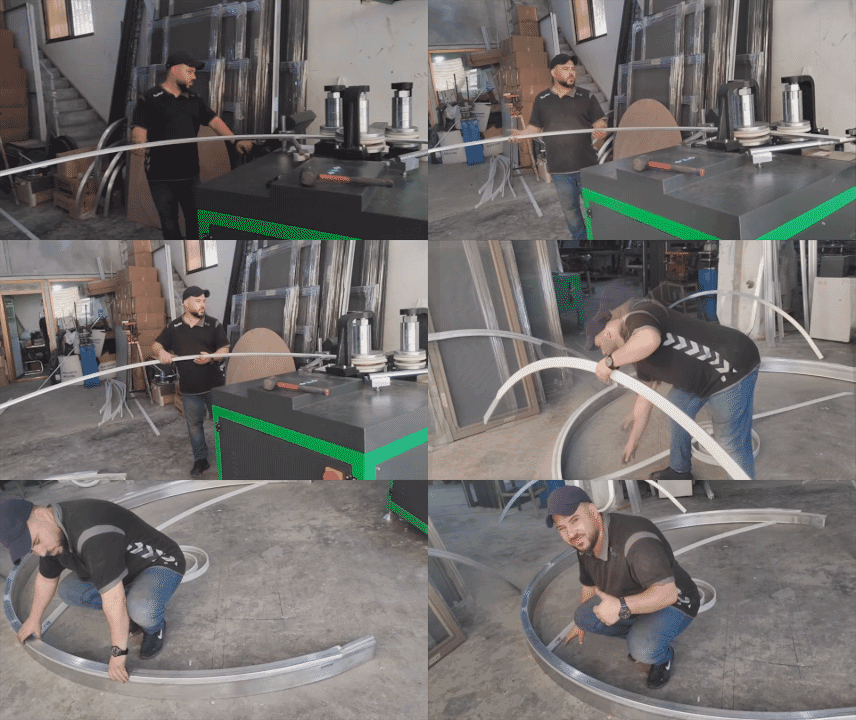
As project demands scale from window frames to massive mullions for the world’s tallest skylines, the machine’s “brain” becomes as critical as its raw thrust. This is the gap that the PBA Series Aluminum Bending Machine was engineered to bridge. It is an all-servo driven workstation that provides between 15 and 70 tons of raw power, capable of mastering strong-axis bending up to 300mm. But its true power lies in its Windows 7-based IPC control system. This isn’t just a bender; it’s a CAD/CAM hub where operators import DXF or STEP files directly. This “What You See Is What You Get” (WYSIWYG) transition eliminates the human error and precision loss inherent in manual coordinate entry.
The pinnacle of this closed-loop control is the integrated laser radius measurement system. Because every batch of aluminum possesses a slightly different temper, the laser monitors the actual radius in real-time as the profile exits the rolls. This data is fed back to the IPC, which instantly adjusts the pressure to compensate for material fluctuations. This real-time correction ensures that whether a component is two meters or fifteen meters long, the curve remains consistent from end to end. In an industry defined by the tension between architectural ambition and metallurgical rea
From Functionality to Artistry
Curtain wall bending is ultimately a marathon of precision. From the arched entrances of subway stations to the curved skylights of commercial complexes, bending technology is allowing urban facades to evolve from rigid straight lines into graceful curves.
As witnessed in advanced manufacturing, superior equipment like the PBA Series Aluminum Bending Machine—combined with scientific parameter control and metallurgical insight—is making once “impossible” radii the hallmark of landmark buildings. In the future of architectural competition, whoever masters the balance of shape, property, and surface will establish a true technical barrier in the high-end curtain wall market.
For the fabricator, this is not just about bending a profile; it is about using digital precision to breathe artistic life into cold metal.